I really didn’t want to write this post.
There are two major measures Idaho voters are being asked to consider, and there has been plenty said about one of them. But HJR 4 has bothered me for a different reason.
At first glance, I was conflicted.
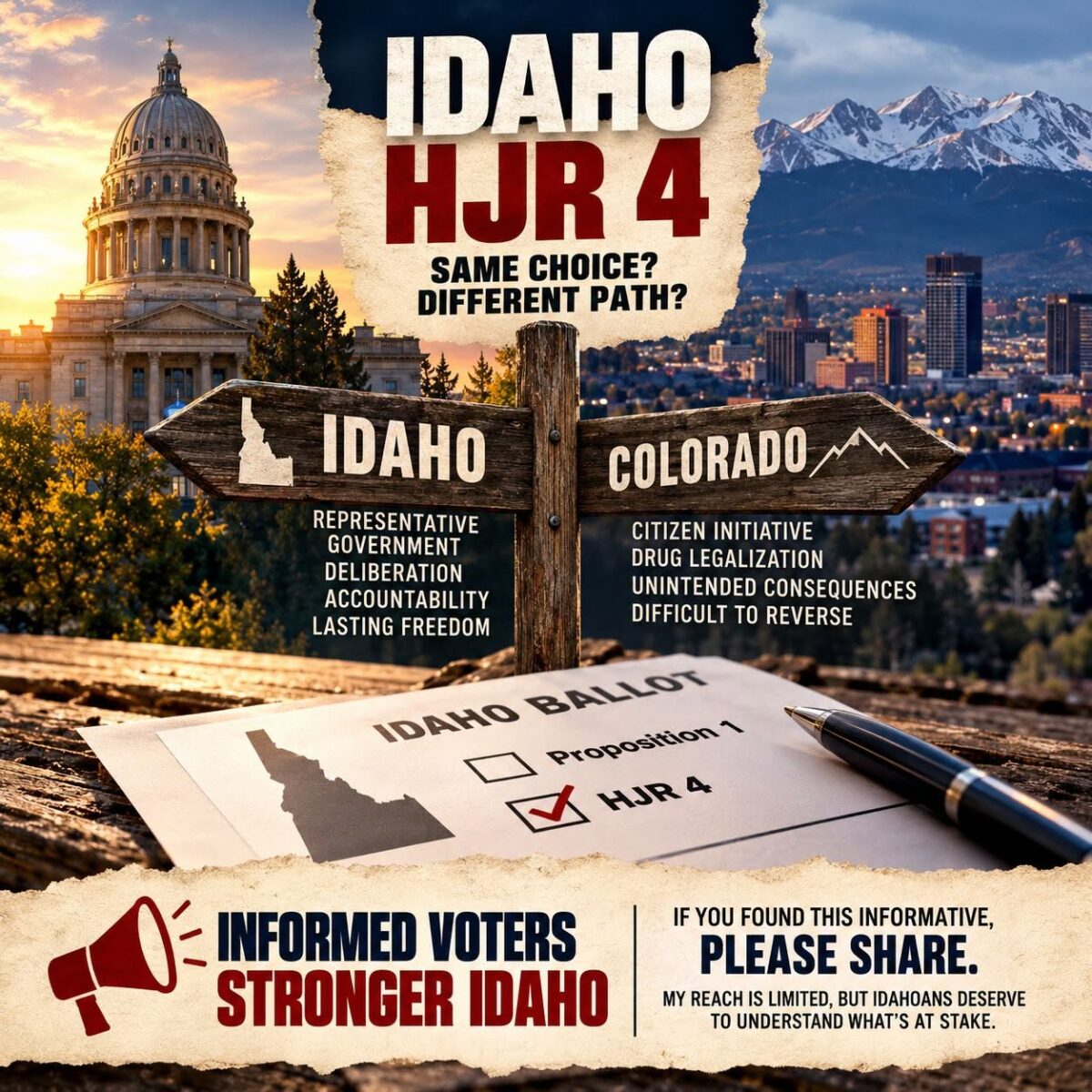
HJR 4 would prevent Idaho’s initiative process from being used to legalize marijuana, narcotics, or other psychoactive drugs. In other words, Idahoans could no longer put drug legalization directly on the ballot through a citizen initiative.
My first reaction was probably the same as many conservatives and libertarians:
Why would I vote to take power away from the people?
That’s a fair question.
But the more I thought about it, the more I realized we may be confusing two very different things:
Our unalienable rights and a particular method of making laws.
The Declaration of Independence teaches that our rights are unalienable. They don’t come from government or even from the Constitution. Government exists to protect them.
The First Amendment protects our right to speak, assemble, and petition our government.
HJR 4 doesn’t take those rights away.
Idahoans would still be free to speak for or against drug legalization. They could organize, protest, petition lawmakers, campaign, elect representatives who agree with them, or replace representatives who don’t.
What HJR 4 changes is something different:
Who has the power to make this particular kind of law.
That distinction matters because America was established as a Republic, not as a system where every law is decided by majority vote.
We elect representatives. They debate legislation, hold hearings, hear opposing arguments, amend bills, and ultimately have to answer to the voters for what they do.
That wasn’t an accident.
The Founders understood that majority rule alone does not necessarily protect liberty. Fifty-one percent of the people should not automatically be able to take away the rights of the other forty-nine percent.
Here is the part of this history I suspect many Idahoans don’t know:
Citizen ballot initiatives weren’t even part of Idaho’s original Constitution.
Idaho became a state in 1890. The initiative and referendum weren’t added until 1912, during the Progressive Era.
That timing is worth understanding.
The early 1900s brought a wave of reforms intended to move government toward more direct popular control. Initiative and referendum were part of that movement.
So was another major change many conservatives are much more familiar with: the 17th Amendment.
Originally, Americans directly elected the House of Representatives, while state legislatures selected U.S. senators. That gave the people a voice in one chamber and the states themselves a voice in the other.
The 17th Amendment changed that and made senators directly elected by the people.
The same era also gave us the 16th Amendment establishing the federal income tax and, shortly afterward, the Federal Reserve Act.
I’m not saying all of these were the same policy or part of some single plan. They weren’t.
But they came during the same remarkable period when Americans were changing some fundamental parts of how our Republic operated. One recurring idea was moving more political power toward direct popular control.
And that should at least make us stop and think when we’re told:
“Taking something off the initiative ballot takes away the people’s rights.”
Does it?
For Idaho’s first 22 years as a state, citizens didn’t have an initiative process at all.
Were they therefore without the right to petition their government?
Of course not.
Petitioning government is a right. Directly making laws by popular vote is a method of government.
Those are not the same thing.
And we don’t have to deal only in theory.
Look at Colorado.
Colorado’s recreational marijuana legalization came through the citizen initiative process. Amendment 64 was placed before the voters and approved in 2012.
Whatever your opinion of marijuana—or of the direction Colorado has taken since—that is an example of exactly the kind of decision HJR 4 is addressing in Idaho.
So ask yourself:
Do we want Idaho to retain a direct-democracy path that could produce the same kind of change Colorado made through its initiative process, or should decisions about legalizing these substances have to go through our elected Legislature?
And look carefully at who is supporting and opposing HJR 4, and why.
There is one more important point.
HJR 4 isn’t being imposed upon Idaho voters without their consent.
We are the ones being asked to decide whether to amend our Constitution.
There is a legitimate argument against doing it. Any time we give up a power currently reserved to the people, we should look at it very carefully.
I understand why that makes people uncomfortable.
It made me uncomfortable too.
But I don’t think “they’re taking away our rights” settles the question.
The real question is:
For something as consequential and difficult to reverse as drug legalization, do we want laws made directly by majority vote—or do we want them to go through our elected Legislature, with debate, hearings, amendments, scrutiny, and representatives whom we can hold accountable?
That’s the question I think Idahoans should actually be discussing.
Whatever you decide, please don’t vote based on a meme, a slogan, or even this post.
Read HJR 4.
Read the arguments on both sides.
Understand what the initiative process is, where it came from, and what the amendment actually changes.
Then vote according to principle.
One final request: If you found this helpful or informative, please share it.
My reach alone is limited, and I believe Idahoans deserve the chance to understand what HJR 4 actually does before they vote—not simply what they’re being told it does.
Whether they ultimately agree with me or not, let’s help people make an informed decision.