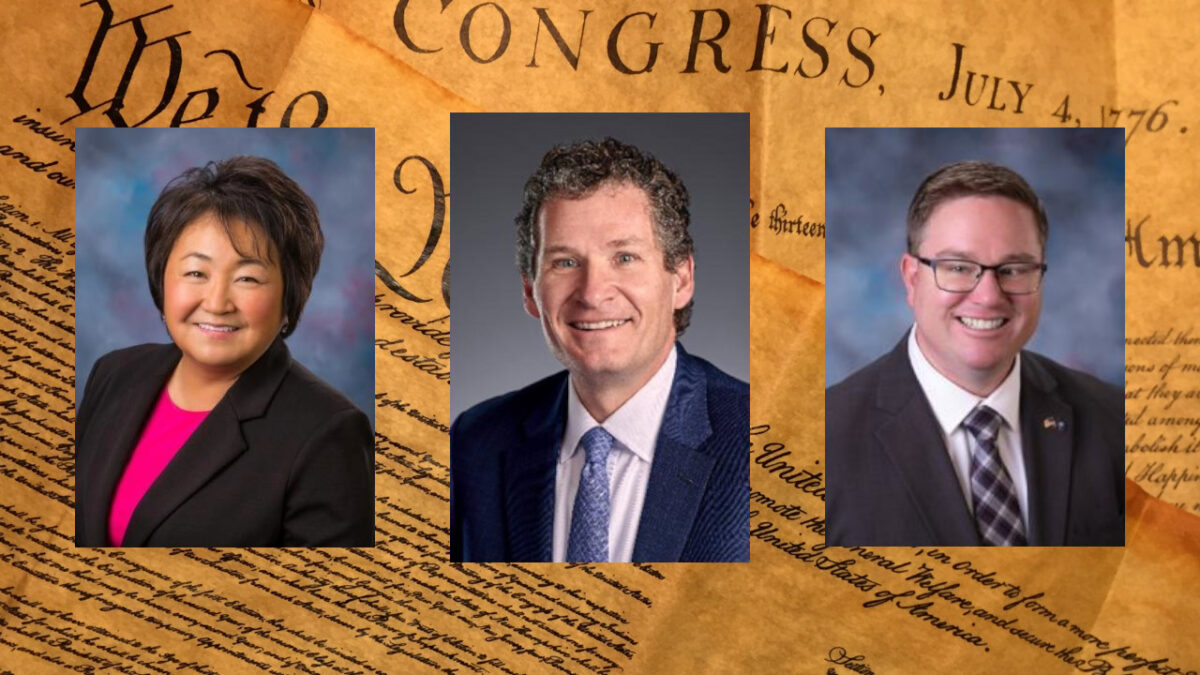
In Idaho’s District 30, the real political story often begins after the votes are cast — when the record reveals not just decisions, but the governing philosophy behind them. The recently circulated “constitutional scorecards” grading Idaho lawmakers offer more than percentages — they expose a deep philosophical divide over what liberty, government power, and constitutional fidelity actually mean in District 30.
Produced by The New American, a publication known for its strong constitutionalist viewpoint, the scorecards evaluate lawmakers based on a limited-government interpretation of the Constitution. Critics will argue the ratings reflect a particular ideology — and they’re right. But dismissing them outright misses the point. Whether one agrees with the framework or not, these scorecards highlight a real and growing contrast in how our representatives approach governance.
And that contrast is hard to ignore.
A District Represented by Three Very Different Legislative Philosophies
District 30 is not politically unified. The numbers alone tell a striking story.
Senator Julie VanOrden earned a 56% rating. Representative David Cannon scored 88%. Representative Ben Fuhriman received a 0%.
That spread isn’t just statistical noise — it reflects fundamentally different instincts about the role of government.
Some lawmakers in our district consistently side with legislation framed around individual liberty, limited mandates, and constitutional restraint. Others appear more comfortable supporting government authority in areas like public health policy, education, and regulatory structure. These aren’t minor disagreements; they represent competing visions of what Idaho governance should look like.
The Middle Ground: Senator Julie VanOrden
VanOrden’s 56% score places her in the ideological middle of District 30’s delegation — reflected in votes such as supporting state income tax reductions while breaking from limited-government groups on higher-education DEI legislation — a position that will likely frustrate activists on both sides.
Her record shows alignment with limited-government principles on taxes and certain criminal justice issues, yet a willingness to break from that philosophy on cultural and education-related legislation. Supporters may call this pragmatic independence. Critics may see inconsistency.
Either way, the scorecard suggests she is navigating — or attempting to balance — two competing political currents inside Idaho’s Republican landscape.
Sen. Julie VanOrden’s Scorecard
The Outlier: Representative Ben Fuhriman
Fuhriman’s 0% rating is perhaps the most politically revealing figure in the entire report — especially for voters who expected a more traditionally limited-government voting record from District 30’s delegation.
According to the scorecard’s framework, none of his highlighted votes aligned with its interpretation of constitutional governance. That doesn’t mean he lacks a constitutional rationale — lawmakers frequently disagree on what the Constitution demands — but it does signal that his approach to policy making diverges sharply from the limited-government lens used in the rankings.
For constituents paying attention, this raises an important question: Is District 30 being represented by a unified philosophy, or by lawmakers moving in entirely different directions?
The Consistent Conservative: Representative David Cannon
At 88%, David Cannon consistently emerges as the lawmaker most aligned with the scorecard’s principles. His votes on medical mandates, constitutional money, and education policy reflect a consistent emphasis on limiting government authority and expanding individual autonomy.
Supporters will view this as ideological clarity. Opponents will likely argue it reflects a rigid worldview. But regardless of perspective, Cannon’s voting pattern appears deliberate rather than situational — a trait that increasingly stands out in a political environment defined by shifting alliances.
What These Scores Really Mean — and Why They Matter
Let’s be clear: no private organization gets to define what is or isn’t “constitutional.” Courts do that. Legislatures debate it. Citizens decide what kind of leadership they want.
But scorecards like this still matter because they force a conversation many voters would rather avoid: not just what our representatives vote on, but why.
Are they prioritizing individual liberty above all else?
Are they balancing liberty with institutional authority?
Or are they redefining conservatism altogether?
District 30 isn’t just represented by three lawmakers — it’s represented by three competing answers to those questions.
The Bigger Picture for District 30
The real takeaway isn’t that one legislator scored higher than another — it’s whether voters in District 30 will start paying closer attention to the votes that quietly shape their community’s future. The takeaway is that our district is politically diverse in ways that don’t always show up in party labels.
When one representative scores 83%, another lands at 56%, and another at 0%, it tells us something deeper: voters here are sending mixed signals about what they expect from their government.
That tension isn’t a weakness. It’s a reflection of a community still debating its own identity — fiscally conservative, culturally engaged, and increasingly aware that “constitutional” can mean very different things depending on who is doing the defining.
And perhaps that’s the most important lesson from these scorecards: the real debate isn’t about percentages. It’s about the future direction of District 30 — and who gets to decide what liberty looks like in Idaho.
For voters who consider themselves strong defenders of the Constitution, this is the moment to look carefully — not just at party labels or campaign slogans, but at the actual voting records behind them. Constitutional language is easy to claim; constitutional consistency is harder to demonstrate. District 30 deserves voters willing to examine both.